

On intellectual lineage, alignment, and building firms designed to endure.
In a 1675 letter to Robert Hooke, Sir Isaac Newton noted that “If I have seen further it is by standing on the shoulders of Giants.” That phrase “standing on the shoulders of giants” has stuck with me for years — first from Newton, and later, perhaps less academically, from Oasis’ fourth studio album, which was on heavy rotation in my middle school years.
Studying those who came before us — learning history and learning from history — is the ultimate form of operating and intellectual leverage. Without that foundation, we are doomed to have to relearn every lesson humanity has ever learned, for ourselves, every time we want to do anything.
Venture capital firms are no exception. They, like individuals, are built on the foundations poured by those that came before us.
In our previous writings – including “Why We Invest in Financial Services,” “Concentrated Conviction,” “Betting on Convexity,” and “Defying Orthodoxy” – we talked at length about what Deciens does, why we do it that way, and how we do it. They describe our focus, our highly concentrated approach, our enduring partnerships with founders, and our willingness to pursue variant processes in pursuit of variant outcomes. Those writings described the visible architecture of the firm – how we make and steward individual investments, construct portfolios, manage risk, and seek to compound capital over decades.
This letter is about something less visible, but no less important: the intellectual and moral lineage underpinning that architecture.
Choosing Your Mount Rushmore
In the world of investing, there are many giants. The pantheon seemingly knows no limit, and it appears to be growing more crowded every year. In Deciens’ chosen specialties of venture capital and financial services, any practitioner worth their salt should be able to define their own murderers’ row of those they have learned from or hope to study (or, even better, study with). My library is full of biographies, autobiographies, and histories covering people and events, large and small, remarkable and mundane, and I know that I am far from alone in that. As Munger was fond of noting, “There are answers worth billions of dollars in $30 history books.”
“Tell me who your heroes are and I’ll tell you how you’ll turn out to be.”
If we can each create our own Mount Rushmore, who do we choose to cast in stone and why? And whose effigies are left on the quarry floor? Choosing whose shoulders to stand on is vitally important, even life-altering, regardless of your line of work or what you aspire to achieve in life. And knowing who someone is building their life on top of helps us understand them better, faster, and more fully. For example, knowing that I model myself more on Charlie Munger than Ken Griffin or Steve Schwarzman gives someone who doesn't know me a more accurate mental model of who I am, and by extension, what Deciens stands for. As Warren Buffett once told a group of students at Emory University, “Tell me who your heroes are and I’ll tell you how you’ll turn out to be.”
Picking well is a massive life accelerant. It can be likened to finding the cheat codes to your favorite video game. Pick poorly, and a person has consumed the most precious resource they have — time, with its infinitely high opportunity cost.
But with all this ink spilled, I still freely admit I don’t have a formula for choosing whose shoulders you should stand on. I wish I could hand you a simple method for picking your heroes, but that’s not something anyone else can decide for you. The search itself is part of the work. Only by coming to know yourself can you recognize the people worth building upon. And in the process of choosing them, you come to understand yourself more clearly.
If, for example, you are trying to build a scaled retail business, studying the work of Sol Price and those inspired by him seems wise. You see these intellectual family trees everywhere — in industry after industry, the lineage is evident:
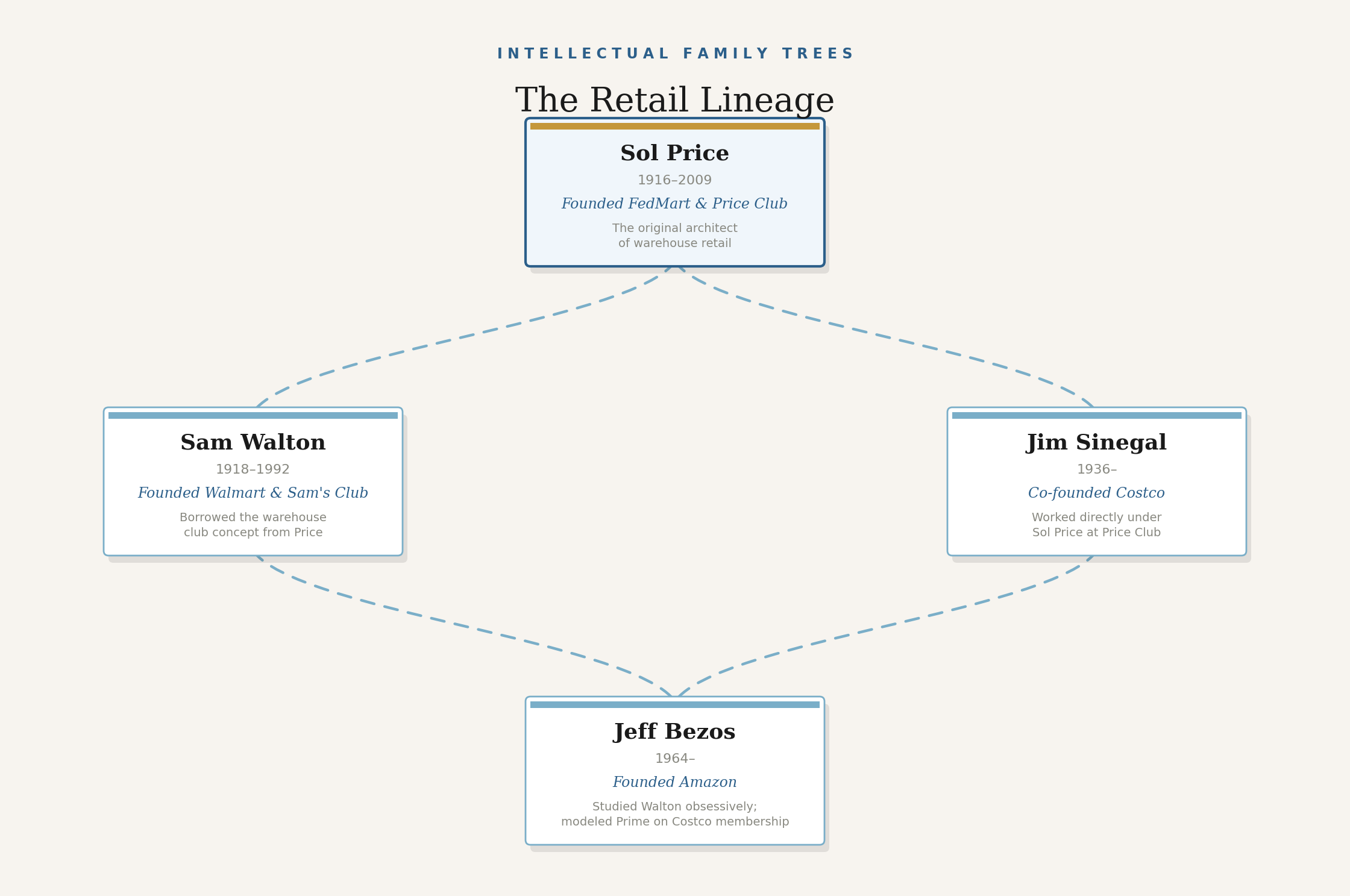
As David Ogilvy put it succinctly, “The good ones know more.”
Conversely, if you want to build a luxury goods business, the world of Brunello Cucinelli, Estée Lauder, or Bernard Arnault is likely a better fit. And a fast-food entrepreneur might find more in the life and work of Ray Kroc or Todd Graves than in reading Danny Meyer’s Setting the Table or watching Jiro Dreams of Sushi.
Just as building on others’ shoulders can, reflexively, help a person figure out who they are, understanding what others have built and accomplished can help someone figure out what they want to build and accomplish. Finding the right fit between a project and its sources of inspiration can be critical in its own right. The correct metaphors and mental models are that powerful.
One reason the choice of shoulders matters is that the work itself rarely stays the same. What begins as one problem often evolves into another, and the mental models you carry can either support that evolution or hold it back. The same is true of the people and organizations you learn from. Some influences matter more early on, when it is all about going from zero to one. Others become more important later, when the questions shift toward scaling and, if fortunate, building something that lasts.
Letting both the project and the shoulders you stand on evolve is not a rejection of earlier influences, but a natural sign of progress.
Lessons Across Domains
If you are, as we are, investors, you’ll probably build upon previous generations of investors, capital allocators, financiers, and the like. But if you are a musician, athlete, chef, etc., you may gain a lot by studying the lives of the pre-eminent and not-so-pre-eminent figures in those domains. At the same time, I think that there is real value in studying those who have walked materially different paths. For example, studying the lives of musicians, athletes, and chefs has been a real eye-opener, even though my own capabilities in those fields are limited and in some cases severely so. Deciens has evolved in reaction to learning from, of all things, restaurants and record producers.
One thing I have learned from studying other disciplines is that those who aspire to be the very best in the world at their craft have more in common with one another than with peers in the same domain who are merely satisfied with being excellent. Going for greatness is its own kind of pathology, regardless of the domain you aspire to greatness in (a pathology we have cultivated at Deciens since day one).
Follow Your Drift, Don’t Fake Passion
If you are still looking for your path, it's hard to know whose shoulders to stand on. If you find yourself in that position, I would simply continue to lean into what sparks your curiosities and passions. Munger put it best when he noted that we should all “follow our natural drift.” Curiosity and passion are the best clues that you are leaning into something that could sustain you for the long term (Paul Graham’s essay “How to Do Great Work” touches on this idea in a different register). That is the one universally necessary condition to achieve whatever it is that you aspire to in life. Even if it takes much longer than it seems it should. Many people did not find their calling till their 40s or 50s, including Ray Kroc, Morgan Freeman, Julia Child, and countless others.
Conversely, thinking that you should be passionate about something or someone is a mistake — whether that belief comes from parents, friends, mentors, the media, or others. I have personally seen many people make this error. In a long life and career, passion cannot be faked. After working for a year — or three, or five — on a problem you have been told to be passionate about, or following in the footsteps you have been told to follow, you will eventually quit if you lack genuine, intrinsic passion. Famously, James Dyson, founder of Dyson Limited, personally built 5,127 prototypes of his cyclonic vacuum cleaner before getting it right. But even if your journey doesn’t require that kind of passion, it will require some, as there are always many trials and tribulations.
“If you are truly following your natural drift, the passion will be real, rather than manufactured. ”
If you, however, have real passion for what you’re doing — or if you truly feel a connection to the work of those whose shoulders you stand on — and you believe in the compounding effects of working on the same problem for decades, then five years feels like just the beginning. When you face the inevitable tough sledding, the passion will carry you through. If you are truly following your natural drift, the passion will be real, rather than manufactured.
Variant Outcomes Require Alignment
Your giants don't have to be individuals. They can also be organizations. In recent years, I have become more focused on understanding the great organizations, rather than simply the people who have built them. Renaissance Technologies and, of course, Berkshire Hathaway are two such organizations. Both have been remarkably successful over a remarkably long period. In thinking about organizations, I revisited an earlier letter on defying orthodoxy. There, I noted that “the only way to have variant outcomes is to have variant people run variant processes. Conversely, if you have median people run median processes, you will have median outcomes.” Variant outcomes do come from variant people and/or variant processes. But my prior statements are perhaps too abstract to be actionable. Variant outcomes do not simply come from variant people or variant processes.
In the intervening three years, I have realized that variant people and variant processes are themselves the outcome of something distinctive: the alignment of a firm’s people, tactics, and strategies. Creating and maintaining that alignment seems to be another precondition, along with intrinsic motivation, for anything approaching success. And to whatever extent that Deciens “works,” however defined, it is because what we do, and how we do it, sits at the nexus of a highly aligned and internally consistent set of people, tactics, and strategies.
The most obvious example of this alignment is how we think about sizing initial investments and reserve deployment. We have always believed that reserves, reserve management, and deployment of follow-on dollars are critical to how Deciens maximizes upside potential and minimizes downside. But it was studying Stan Druckenmiller, Ho Nam, and the Nomad Investment Partnership that really crystallized our beliefs that position sizing is key to driving returns and that due diligence can only really begin at the closing dinner. Also, understanding the impact that PE firms have by deploying human capital alongside financial capital inspired us to hire Vishal and to codify our portfolio support model.
Playbooks, Fit, and the Danger of Mismatch
If you believe there are many ways to succeed in venture capital, then what becomes clear is that our team running a different playbook seems unlikely to work. We are not, for example, the right people to run a late-stage, momentum strategy, predicated upon being invited to the correct parties on Sand Hill Road. We would be so poorly suited to it as to be almost laughable. And, conversely, another team running our playbook is also seemingly doomed to failure from the jump. They would struggle with a remote-first, highly concentrated, research-driven approach that emphasizes capital efficiency and long-term compounding of capital over being on the venture capital hamster wheel. Learning from the great organizations, venture capital or otherwise, is one way to understand the power of alignment in creating something truly special, and to determine what alignment means for any given team or organization.
I have often written to you about how different I believe Deciens is and my willingness to eschew many of the norms of our industry in the pursuit of greatness, even if that makes others uneasy. I am comfortable doing this because I have spent the better part of two decades studying the history of venture capital, the models that different firms practice, and how they do or do not work over time. I have learned from the giants (real and self-proclaimed) and know which I care to stand upon and which have no place on my personal or Deciens’ Mount Rushmore.
Recognizing that we see ourselves much more in the vein of Sutter Hill, Altos, USV, or Benchmark helps outsiders understand what we do and why we do it better. We all share a similar core practice: leading early rounds in a concentrated portfolio, grounded in a fundamental belief in the power of non-concensus investing. In particular, Altos’ “hedgehog” approach — focused on low dilution, hedging existential financing risk, and compounding over many years in businesses with deep moats — is itself built on the Buffett-Munger-Graham approach. For though we might appear iconoclastic, we are simply standing on the shoulders of different giants from many of our peers.
Similarly, it’s important to recognize that we look to enduring organizations — like Capital Group, now in its ninth decade of serving clients, or Berkshire, with its enviable 60-plus-year track record of compounding capital — rather than trying to be the next shining star (that burns brightly before fading into obscurity). Our operating model is more akin to Alpine Investors or KKR than to “traditional” seed-stage funds. We believe that understanding Don Valentine’s legacy, as memorialized in a monograph by Michael Moritz, or studying the writings of Nick Sleep, is a far more compelling use of time than being drawn into the latest social media hullabaloo or flame war, let alone a party on Sand Hill Road. Knowing these things helps others see us more clearly and fosters a community aligned with who we are, both as a firm and as people.
In Closing
I know whose shoulders I stand on and am very thankful for the support they have provided me, and continue to provide, in building Deciens. The greatest of those giants did not set out to be learned from – they set out to be great, and the lessons followed. I hope that everyone finds their set of shoulders on whatever journey or journeys they undertake, and that someday, someone finds it worth standing on yours.
If we do our jobs well, perhaps Deciens will be among those shoulders one day.
