
The Deciens Outlook

Partner perspectives on markets, portfolios, and priorities for 2026.
As we enter 2026, the venture landscape is being shaped by strong crosscurrents: geopolitical uncertainty, policy intervention, and rapid technological change.
To frame how we’re thinking about the year ahead, we asked each member of the Deciens leadership team to share their perspective: from macro and policy dynamics, to portfolio evolution, to firm priorities and founder qualities we believe matter most.

A Volatile Macro Backdrop
2026 has begun with a highly tumultuous and chaotic macroeconomic landscape both in the US and globally. From geopolitical developments in Venezuela, Iran, and Europe to protests in Minneapolis and a flurry of executive orders and directives affecting the housing sector, defense contractors, and credit card companies, the first weeks of January have been marked by significant global and domestic uncertainty. As we wrote at the beginning of 2025, we expect continued volatility and uncertainty to be the prevailing theme for 2026.
Financial services are a major part of the domestic story. The administration has clearly signaled it wants to reduce consumer costs, as inflationary pressures and a weaker job market are affecting perceptions of the economy.
Targeting Household Costs: Housing and Credit
The two immediate areas the administration is targeting are housing affordability and credit card fees. According to Goldman Sachs, housing affordability remains at its lowest point this century (other than the beginning of the global financial crisis), following a sharp decline in 2021. The administration has (i) begun to exert pressure on homebuilders to increase supply and lower prices, (ii) directed Fannie Mae and Freddie Mac to purchase $200B in mortgages in an effort to bring down mortgage rates, and (iii) put a moratorium in place on investor purchases of single-family homes to blunt any role they may have played in rising home prices.
Credit card fees had not been a recent topic of discussion, but they were among the issues Trump raised during his campaign. His current executive order calls for credit card companies to cap interest rates at 10% for one year, down from the current average of 20-30%. This would have a significant impact on the credit card, banking, and payments ecosystems — and likely on the broader economy — as the prevailing view from key players is that it would meaningfully constrict the availability of credit.
New Regulatory Tools and the Fintech Outlook
The administration’s initiative regarding defense contractors — restricting their ability to pay dividends or conduct share buybacks — does not directly impact the financial services sector. However, it does unlock a new tool in the administration’s toolbox that could be leveraged in other sectors, including financial services, to drive compliance with directives like those outlined above.
There remain many questions about the directives affecting homebuilders and credit card fees, making it unclear what will be implemented and what effect they will have. What is clear, however, is that the administration’s focus on lowering household expenses is landing squarely on the financial services sector to start. That focus could lead to additional proposals or changes over the course of the year, which, by their nature, would also impact fintechs operating in these markets — something we will be watching closely.
AI’s Deepening Impact
The AI revolution remains the primary focus of the venture capital ecosystem as a whole. We expect this to continue unless there is a market drawdown. The economy is also becoming increasingly levered to AI as (i) it’s responsible for much of the growth in the country and (ii) it has spread to real assets and the debt capital markets because of the massive pace of data center construction.
Within our portfolio companies, we are seeing founders start to see the technology evolve to a point where it is making many — if not most — of them fundamentally rethink their assumptions about how to develop technology, how to do more in parallel, and what may soon be possible to build that simply was not before. AI will continue to bring both opportunities and risks in 2026 for the country and for startups, but its potential to meaningfully change our world is now clearly on the horizon.
Funds I and II: Breakouts and Compounding Growth
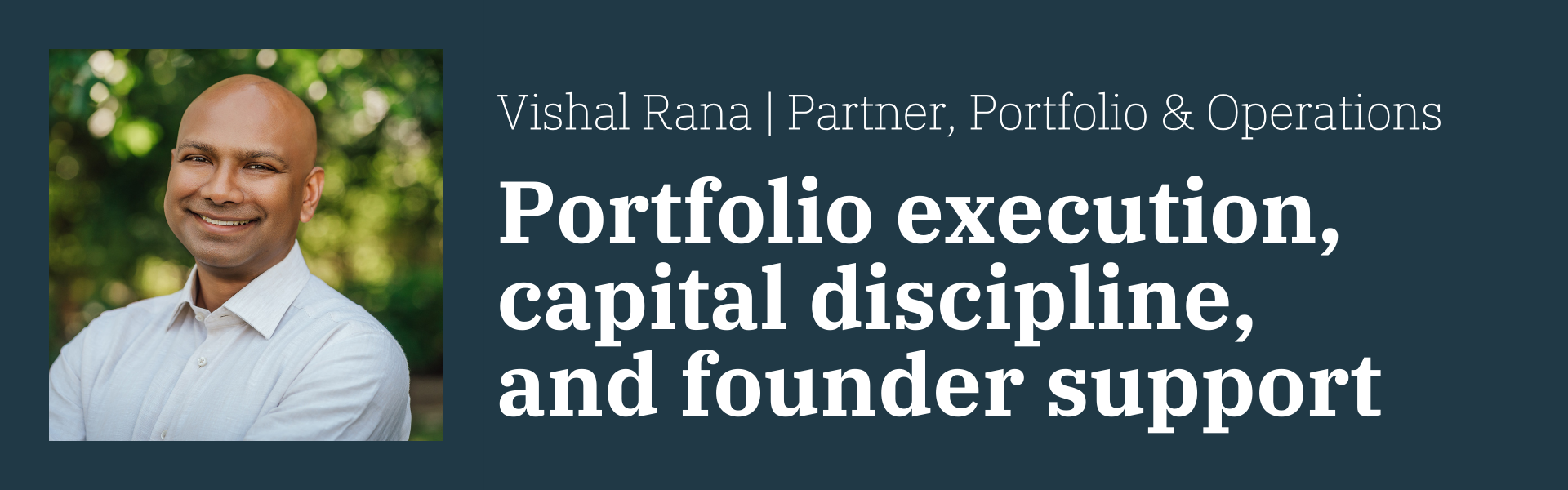
Let’s start with the current state of affairs. The companies in our portfolio are at various stages of growth. Five of the twelve Fund I and II companies have now achieved more than $10M in run-rate annual revenue, raised Series A or later capital, and have professional leadership teams in place. Those companies will continue to compound while consuming very little capital. They may never need to raise money again and are the clear breakouts of their respective funds.
A further four have raised — or are in the process of raising — additional capital to fuel continued growth, but similarly have mature leadership and go-to-market motions, with run-rate revenue in excess of $3M. All of these companies are poised to generate strong returns for their respective funds.
The remaining three companies have paying customers, but have not yet hit the breakout growth and repeatability that would make us confident in their contribution.
Those in the first category are off to the races. They are upgrading their capabilities daily by launching new products, hiring and developing talent, and upgrading infrastructure across the company with AI tools. We expect to see more of the same from them.
The second category will spend time raising capital and refining unit economics to improve capital efficiency. None of these companies fit the “flashy AI” profile currently en vogue in capital markets, making continued capital raises an expensive proposition both in time and dilution.
The third group will continue to experiment with their go-to-market motions to drive meaningful growth.
Fund III: Sprinting Out of the Gate
Fund III has an extraordinary group of founders. Most are just moving with exceptional velocity and hitting launch milestones at an impressive pace. June Point has already started issuing interest rate locks. They went from initial funding to a full-fledged mortgage lender in just five months! Transparency Analytics has completed its SEC application, which included getting ten institutional investors to pay for their ratings – no easy feat. These two companies are truly sprinting out of the gates.
The Capital Environment: Efficiency and AI
I mentioned this earlier, but raising capital in this highly concentrated, AI-focused environment increasingly requires either a compelling AI story or exceptional growth — ideally both. Growth is returning as the dominant driver of investment interest. The name of the game is either grow very quickly or figure out how not to need additional capital. Mediocre growth paired with mediocre profitability is a recipe for tough times.
As we work with our companies, we’re creating pressure to ensure they build for strong unit economics from the outset. Historically, companies would enter a large market, scale expensively — often by hiring more people — and then eventually have technology teams automate the work to make it profitable. Now, businesses are exploring markets using prototypes and automation enabled by modern AI tools, minimizing rework and making products and services economically scalable from the start.
Operational Support: The “Third Co-Founder”
While we focus on companies that can scale rapidly, we take a much more artisanal approach to our work. Dan, Ishan, and I are continually seeking the best way to support our companies, and there is no one-size-fits-all approach.
For our earliest-stage companies, we often serve as a “third co-founder,” providing perspective from having seen the founding journey many times before and helping them navigate early organizational decisions, such as whether to adopt an in-office or remote work policy. There are also plenty of decisions that easily fall into an analysis-paralysis trap — such as choosing a payroll or expense management provider. We help founders think through second- and third-order effects to make the right decisions for their company. And, we’re there to short-circuit the analysis and just tell them who everyone else is using.
In addition, we’re evolving our team to engage more expertise in specific areas. Over the past year, we’ve engaged experts in our network with a focus on sales, engineering, finance, and support. This year, we’ve expanded our network to include folks in marketing, product, operations, and beyond. We’re always looking for strong operators who want to get involved with our companies. We’re especially grateful for those still in the field, learning and applying the newest approaches as technology and techniques continue to evolve rapidly.

Strategic Priorities: Sourcing, Support, and Culture
We were fortunate to complete the final close of Fund III in 2025, so one of my top priorities for 2026 is finding exceptional companies to join the Fund III portfolio. Another key priority for the year is to continue partnering closely with our existing portfolio companies across Funds I & II as they grow and mature into category leaders.
My final priority is working with my colleagues to strengthen our team further. Our distinctive people, culture, and processes are the superstructure that enables all the work we do. Without them, none of this would be possible.
Defining Success: The Pace of Execution
For Deciens, the first priority is continuing to find great companies to partner with. Since starting the firm, we have, on average, added three new companies to the portfolio each year. I want us to maintain that pace in 2026. If we do that — and continue to have our 18 current portfolio companies execute at or above their annual operating plans — it will be a great year.
Each company is on its own journey, with its own metrics and milestones. We do not take a one-size-fits-all approach to company building. At a high level, however, our goal is for all our companies to compound the value of their equity by growing quickly while maintaining very high levels of capital efficiency. That creates a constant balancing act, weighing the relative merits of profitability, growth, and innovation. Combined with ensuring the right people are in the right seats, with the right incentives, and clear alignment on goals and priorities, it keeps both the Deciens team and our management teams plenty busy.
Avoiding Stasis: Navigating the AI Shift
Stasis is the killer of venture capital-backed companies — they thrive on change. We are living through a period of tremendous change across social, political, economic, and technological dimensions. That is inherently exciting. The real question is how to distinguish between changes that are in the foreground — those that are investable and can drive outcomes for Deciens and our stakeholders — and those that are simply part of the backdrop. How do you distinguish the signal from the noise when the volume is turned all the way up?
The most obvious example is the current inflection point in AI’s evolution. We believe AI will change both what businesses are built and how they are built. And it will undoubtedly move the share price for any company that can wrap itself in its cloth, deserved or not. What interests and excites me most, however, is how AI can reshape businesses that sit two or three steps removed from the hype machine. These non-obvious impacts feel like the most fruitful sources of opportunity today.
Deciens’ Founder Profile: “Modern Day MacGyvers”
As a firm, we have long sought founders with a demonstrable track record of overcoming adversity, who are relentlessly resourceful (what we call “modern day MacGyvers”), and who offer distinctive solutions to timeless problems. In a world that is rapidly evolving, across nearly every dimension, these traits are more important than ever.
With rapid and unpredictable change as the only constant, we want to back founders with the greatest flexibility, adaptability, resilience, and clarity of vision. Those qualities enable them to navigate whatever the world throws their way — because today’s challenges are tomorrow’s opportunities.
Closing Thoughts
Across markets, portfolios, and firm strategy, one theme is consistent: this is a year that rewards clarity, discipline, and adaptability. Volatility and change are not headwinds to avoid, but conditions to understand and navigate intentionally. At Deciens, our focus remains unchanged — partnering with exceptional founders, supporting companies with a high-conviction, hands-on approach, and building durable businesses that can compound value through uncertainty.
As 2026 unfolds, we’ll continue to share what we’re seeing, learning, and building alongside our founders and partners. On that note, be sure to sign up for our newsletter to get the latest musings in your inbox monthly.
Here’s to the year ahead.
